


With the Right Support, Sustainable Agriculture Can Take Root
Nature United’s Survey Shows That Canadian Farmers Believe in Sustainability, but Financial Risk and Uneven Support Systems Are Slowing Adoption
“I always say that the difference between a good farmer and a bad farmer is two inches of rain,” says Dakota Odgers, quoting an old farming adage. But for this fifth-generation producer, it’s not just about how much rain falls. It’s about how much the soil can hold. In an era of tightening margins and unpredictable weather, that can mean the difference between a profitable season and a devastating financial loss.
That reality drove Odgers into his fields one day when rain pummeled his farm near Spy Hill, Sask. He wanted to see how a conventional monocrop canola field was faring compared to one planted with a diverse cover crop, a sustainable practice designed to help soil absorb and retain water.
The difference was clear. In the canola field, water pooled and gushed around his boots. But just 100 metres away, the ground in the other field was firm.
“There wasn’t even mud on the bottom of my boots,” Odgers recalls. “There’s no denying that [the approaches] we’re doing here are making a difference.”

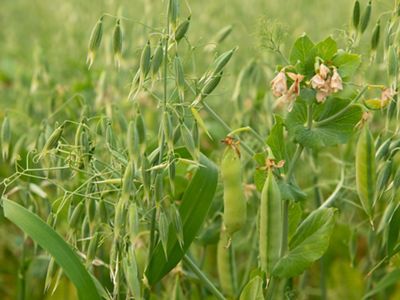


The contrast underscores what sustainable agriculture can offer. By working with natural processes rather than relying solely on energy-intensive inputs, producers can build long-term productivity into their land. It’s an approach that’s been possible for decades—and one that can strengthen farm operations while helping mitigate climate change. Yet adoption remains sporadic. Most producers say they support sustainability, so why haven't more made the shift?
To find answers, we surveyed 509 farmers and ranchers across Canada for our 2025 Producer Survey. Building on our 2024 research, the survey delves into what’s preventing producers from adopting sustainable practices. The findings point to a familiar set of obstacles: return on investment, lack of technical support and peer pressure. Understanding them is the first step in finding the way forward.
The ROI gap
New to this year’s survey, we asked producers directly if they support sustainable practices — and 71 percent said yes. The challenge is whether they can afford to take risks when payback periods are unclear and upfront costs are high. Return on investment was the top barrier for six of the nine practices we studied. For example, among producers who tried cover cropping and then stopped, 64 percent cited a lack of return. Nearly half of those who continued said returns remain insufficient.
The findings reflect the harsh economic realities of the industry.
Farmers pay retail prices for everything they need to grow a crop but sell what they produce at wholesale, says Les Fuller, Nature United’s Agriculture Strategy Director. “The profit margins are very thin. When input prices increase at the same time that market prices decrease, it is really tough to stay afloat.”

Gilles LeBlanc knows the math. He farms 1,800 acres in Wakaw, Sask., on land his grandfather homesteaded in 1921. Over the past six years, his input costs have climbed from around $350 per acre to as high as $600 per acre. Commodity prices haven’t kept pace.
“I’m not losing money,” he says. “But it’s tough to try and move forward with something new when your return on investment is already lower.”
Take variable-rate fertilizer systems, which use GPS and soil mapping to apply different amounts of fertilizer across a field—more where the soil needs it, less where it doesn’t. The technology can reduce costs and improve yields, but upgrading can cost anywhere from $30,000 to $300,000, and the machinery itself is often sized for larger operations.
“The big companies are not making equipment for smaller farmers anymore,” LeBlanc says.
Lost in translation
Across regions and practices, our survey surfaced another obstacle—a lack of trusted, localized advice. Even when interest is high, many said they lack access to agronomists with experience implementing sustainable practices at farm scale. Without that guidance, early attempts often stall or get abandoned.
“They don’t see the research proving out these practices. They don’t see their neighbours doing it. And they don’t see industry supports to help cover the additional risk,” says Warren McAuley, Nature United’s Prairies Agriculture Program Manager.


The research exists; it’s conducted at universities and federal institutions and published in journals. But extension programs, which once helped turn academic findings into practical farm-level guidance, were cut decades ago, leaving producers on their own.
LeBlanc saw that absence first-hand when, in the 1980s, his father sought to work with the land rather than against it. He experimented with intercropping, the practice of growing two or more different crops in the same field to mimic natural diversity, and reduced inputs, a strategy to decrease the use of chemical fertilizers and pesticides. But after about a decade, he was forced to give it up.
“There was no network of people to help him… so he struggled with it.”
Language confusion only compounds the problems. Terms such as “regenerative” and “sustainable” are often used interchangeably, and individual techniques can mean different things to different producers. Without shared definitions, trust is tenuous and comparing outcomes becomes difficult.
Quote: Warren Mcauley

A field with green still growing long after harvest can draw side-eye from neighbours who assume something went wrong. With some sustainable practices, however, some of those plants are providing a benefit going forward.
What the neighbours think
Then there’s the barrier that rarely shows up in formal research. In agriculture, what your neighbours think matters. It’s called “coffee row.”
“It’s where farmers sit down for coffee and talk about what others are doing,” McAuley explains. “There’s a stigma of stepping out beyond normative agriculture. You don’t want to be the topic of conversation on coffee row in the mornings.”
Part of the stigma comes from what others can see, but don’t necessarily understand. A field with green still growing long after harvest can draw side-eye from neighbours who assume something went wrong. With some sustainable practices, however, “some of those plants are providing a benefit going forward,” McAuley says.
But if peer pressure is part of the problem, it can also be part of the solution. Producers trust what they see working on a neighbour’s land. When someone down the road tries something new and it works, it can open a door.
Odgers has seen it happen in his own community. “People are more open to [change] now than they were five or 10 years ago,” he says.

A new kind of “coffee row”
That growing openness is what we’re building on. Nature United’s Model Farm Network is designed to bring small groups of producers together to test practices collaboratively over five years.
Our first network launched in the Melfort, Sask., area. Six farms are enrolled, with four more in the queue. LeBlanc and Odgers are both part of the program. A second network is being established in southwest Manitoba. Our goal is to generate practical, farm-scale evidence from working operations where economics matter.
By connecting producers to test different practices during the same growing season and compare results in the fall, the network eases the burden of experimentation and builds the kind of trust that formal research alone can’t.
“I don’t have to try everything on my farm this year because someone else is going to try it on theirs,” Odgers says of the immediate value.
And with that pressure lifted, he can focus on what matters most — building a healthier operation for the next generation. “When I have kids, it’s about leaving [the farm] in a good spot for them.”
More Stories

The Economic Power of Natural Climate Solutions
A conversation with Amanda Reed of Nature United and Mike Wilson of the Smart Prosperity Institute.

Farming for Strong Markets and a Sustainable Future
Investing in Natural Climate Solutions can help businesses achieve sustainability outcomes and support producers, while also protecting the planet.

Land Ethic for Canada’s Farmlands
A conversation with our Agriculture Strategy Director, Les Fuller, about transforming agriculture through Natural Climate Solutions.